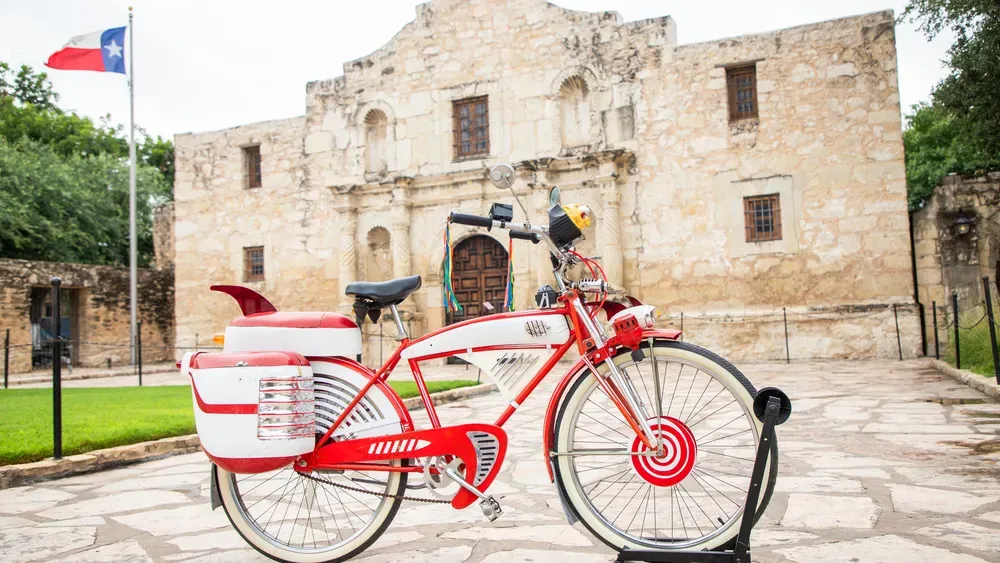
In this undated photo provided by The Alamo Trust, Inc. on Monday, July 21, 2025, shows Pee-wee Herman's original stunt bike from the 1985 film, "Pee-wee’s Big Adventure," in San Antonio, Texas. Photo Credit: (The Alamo Trust, Inc. via AP)
The Alamo has acquired Pee-wee Herman's iconic bike from the 1985 film "Pee-wee's Big Adventure."
It took 40 years, but Pee-wee's bike is now at the Alamo. Just not the basement.
The Alamo announced last week it had acquired and would display the iconic bike from the 1985 Tim Burton film, “Pee-wee's Big Adventure.”
The San Antonio landmark plays a key role in the film chronicling Pee-wee Herman's search for his stolen bicycle when a devious fortuneteller tells him the bike is located in the Alamo's basement. Pee-wee, played by the late Paul Reubens, learns the Alamo doesn't have a basement, but hasn't stopped tourists from tongue-in-cheek inquiries.
“It's the most common question our guest services team hears is, ‘Where is the basement at the Alamo?'” said Jonathan Huhn, senior communications director for the Alamo Trust, Inc., the nonprofit organization that oversees the Alamo's operations. “It's an iconic piece of Alamo pop-culture history.”
The red-and-white bike — or as Pee-wee calls it in the movie, “the best bike in the whole world" — is adorned with streamers on the handlebars and a lion emblem at the front. Huhn said it was acquired from an auction in Los Angeles.
The bike will serve as a centerpiece in the Mays Family Legacy Gallery, which examines the the Alamo’s cultural impact, part of a new visitor center and museum slated to open in fall 2027. It will join other pop culture items including memorabilia from the 1960 movie about the Alamo that starred John Wayne.
“It's really a pop culture bridge" that will bring people to learn about the Alamo's history, Huhn said.
But before then, the bike will go on display for a limited time at the Ralston Family Collections Center. The Alamo also plans to host a free public screening of “Pee-wee's Big Adventure” in Plaza de Valero. More details about dates for the display and the screening will be released later.
Unlike the Alamo, the building where Pee-wee's bike will eventually be located does have a basement. But, before you ask, that's not where the bike will be.
by Andrew Demillo
Copyright Associated Press. All rights reserved. This material may not be published, broadcast, rewritten, or redistributed.
In the heart of upstate New York, the Finger Lakes region—anchored by the progressive college town of Ithaca—has quietly emerged as one of North America’s most welcoming, queer-friendly travel destinations.
While cities like San Francisco, Toronto, and Palm Springs often dominate discussions about LGBTQ+-friendly travel, the Finger Lakes region of upstate New York is steadily gaining ground as an inclusive destination for queer travelers. Ithaca, a small city nestled among rolling hills and cascading waterfalls, stands at the center of this transformation, offering a blend of progressive values, active community organizations, and a calendar filled with events designed to celebrate diversity and inclusion .
Ithaca’s reputation as a queer-friendly destination is rooted in its vibrant community and longstanding commitment to equality. The Ithaca Pride Alliance, a local nonprofit, plays a pivotal role in promoting visibility, safety, and connection for lesbian, gay, bisexual, transgender, and queer residents and visitors. Each June, the region hosts the SoFLX Pride Festival, which includes not only parades and live entertainment but also Camp Fruit Fly—an overnight program specifically designed for rural queer youth aged 15-18. This camp emphasizes classic summer experiences in a safe, affirming environment, underscoring the area’s commitment to supporting LGBTQ+ people of all ages .
But the celebration doesn’t end with Pride. Throughout the year, Ithaca and surrounding towns host a range of inclusive events, from drag brunches in downtown cafes to queer film screenings at the historic State Theatre. The Inside Out Film Festival, which began in Toronto, has inspired a local offshoot, bringing international LGBTQ+ cinema to rural audiences. These events foster a sense of belonging and make the region more than just a seasonal stop for queer travelers—it’s a year-round destination .
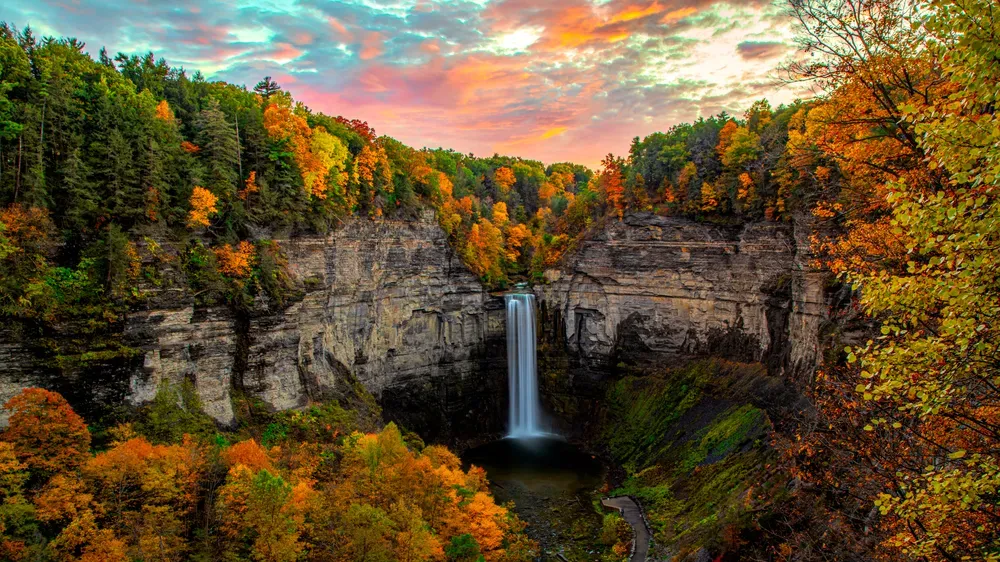
Beyond community events, the Finger Lakes region’s natural beauty is a major draw. Known for its picturesque lakes, dramatic gorges, and lush vineyards, the area offers endless opportunities for hiking, kayaking, and wine tasting. Many of the region’s wineries and bed-and-breakfasts proudly display rainbow flags, signaling their commitment to hospitality for all. Corning, a nearby city, has been specifically recognized as one of the most LGBTQ+-friendly small cities in the United States. Its welcoming attitude is reflected in local businesses that support queer causes and host regular outreach programs .
The Finger Lakes’ approach to LGBTQ+ inclusion has global relevance. As anti-LGBTQ+ legislation and sentiment rise in some areas, many travelers are seeking destinations where they feel not only safe but celebrated. The success of Ithaca and its neighboring towns demonstrates how rural areas can foster genuine inclusivity through grassroots organizing, visible support from local businesses, and a commitment to intersectionality that includes transgender people, nonbinary individuals, and people of color .
The growing popularity of the Finger Lakes among LGBTQ+ travelers is influencing the local economy and culture. More queer-owned businesses are opening their doors, tourism boards are actively marketing to LGBTQ+ audiences, and collaborations between local governments and advocacy groups are strengthening anti-discrimination protections. The region’s success offers a blueprint for other rural communities across North America and beyond.
For travelers seeking an authentic, welcoming experience off the beaten path, Ithaca and the Finger Lakes are more than just a retreat—they’re a testament to the power of community and the enduring value of queer visibility in every corner of the map.
The Santiago Resort in Palm Springs stands as a beacon for LGBTQ+ travelers seeking safety, comfort, and community in one of the world’s top queer tourist destinations.
Palm Springs, California, is internationally renowned as a haven for LGBTQ+ travelers, offering a vibrant mix of nightlife, events, and inclusive businesses that cater to visitors from all walks of life. Among its many acclaimed establishments, The Santiago Resort stands out as a boutique hotel specifically designed for gay men, providing a sanctuary of acceptance, relaxation, and camaraderie in the heart of the desert .
Founded with the vision of creating a safe and welcoming environment, The Santiago Resort has been a fixture in Palm Springs’ LGBTQ+ hospitality scene for years. The property is frequently highlighted by LGBTQ+ travel authorities for its unwavering dedication to inclusivity and guest well-being. The resort's mission is to serve as "a place where guests can feel completely at ease, free from the pressures of the outside world," according to its official statements and guest testimonials .
The Santiago is part of a broader network of LGBTQ+ welcoming tourism businesses promoted by organizations such as the International LGBTQ+ Travel Association (IGLTA), which recognizes establishments that meet high standards for inclusivity and guest care .
The Santiago Resort is an adults-only property, designed to foster connection and relaxation among its guests. It offers a range of amenities, including:
- Spacious, well-appointed rooms - A large heated pool and spa area - Lush, private gardens - Complimentary breakfast and snacks - Clothing-optional poolside environment
The resort’s design is intentional in creating spaces where LGBTQ+ guests, particularly gay men, can socialize freely and build connections in a judgment-free setting .
Beyond its hospitality offerings, The Santiago Resort is deeply involved in supporting LGBTQ+ causes and events in Palm Springs. The property regularly partners with local charities, sponsors pride celebrations, and participates in initiatives that benefit the broader queer community. For instance, during Palm Springs Pride and other major LGBTQ+ events, the resort hosts mixers, pool parties, and wellness retreats that bring together travelers and locals alike .
These efforts align with Palm Springs’ reputation as a progressive and welcoming city, where nearly half of the local population identifies as LGBTQ+ and city leadership is openly supportive of queer rights. The resort’s staff receive ongoing inclusivity training to ensure all guests, including transgender people and nonbinary individuals, feel welcomed and respected at every interaction .
The Santiago Resort’s commitment to LGBTQ+ inclusion has not gone unnoticed. Its profile is raised by organizations such as the International LGBTQ+ Travel Association and Queer Destinations, both of which highlight the property as a model for queer-friendly hospitality .
The resort is also featured on the Everywhere Is Queer map, a public resource that connects travelers with LGBTQ+-owned and queer-affirming businesses worldwide. This visibility helps LGBTQ+ travelers find safe and joyful spaces where they can be themselves, demonstrating the importance of such resources in the global tourism industry .
Safety remains a priority for LGBTQ+ travelers, particularly as laws and social attitudes vary significantly across different regions. Palm Springs and The Santiago Resort are frequently cited among the safest and most affirming destinations for the queer community, bolstered by local policies and a supportive tourism sector .
The Santiago Resort’s ongoing commitment to safety, discretion, and guest privacy allows individuals to relax, recharge, and connect with others in an authentic way. As the industry continues to evolve, properties like The Santiago are setting the standard for what LGBTQ+ hospitality can and should be—empowering travelers to explore the world with confidence and pride .
The Backstreet Boys have debuted a playful and viral airline safety video parody, blending their iconic pop persona with travel safety instructions.
The Backstreet Boys, legendary for their chart-topping hits and global fanbase, have released a new viral video that reimagines the often-overlooked airline safety demonstration. Debuting on July 17, 2025, the “BSB Air” safety video was shared across YouTube, Instagram, and TikTok, immediately captivating fans with its blend of humor, musical references, and playful banter between band members .
Opening with the classic greeting, “Hello and welcome to BSB Air,” the safety video immediately signals a departure from the mundane. The Boys riff on traditional safety instructions—demonstrating oxygen mask use with a wink, referencing Las Vegas party culture with a nod to air sickness bags, and gently poking fun at seatbelt procedures. The segment even jokes about the ubiquity of mobile phones—“Make sure all cell phones are on airplane mode, unless you’re listening to me”—while maintaining the essential information necessary for in-flight safety .
The parody is peppered with inside jokes and self-aware references, including the line, “We’ve been through worse,” as they explain emergency procedures, and playful jabs at their own pop stardom. Throughout, the Boys’ camaraderie and chemistry are on full display, reminiscent of their heyday yet refreshed for a new era .
For many LGBTQ+ fans, the Backstreet Boys have long been a source of joy, nostalgia, and safe space within pop culture. Their enduring appeal is rooted not just in catchy music but also in a message of acceptance and fun that transcends boundaries. The band’s willingness to embrace camp and parody in this safety video echoes the spirit of drag culture and queer humor, where reinvention and playfulness are celebrated .
Social media reactions from LGBTQ+ viewers highlighted how the Boys’ self-aware, inclusive, and flamboyant delivery resonated with communities that often look to pop culture icons for affirmation and visibility. Many commented on the video’s “campy” energy—a hallmark of queer entertainment—and the band’s ongoing relevance as allies and entertainers who never take themselves too seriously .
The viral success of the BSB Air safety parody underscores the power of nostalgia and humor to bring together diverse audiences. For fans who grew up with the Backstreet Boys—and for younger generations discovering their music anew—the video is both a throwback and a fresh reminder of how pop culture can bridge divides.
While the safety demonstration itself is not explicitly tailored to LGBTQ+ themes, its embrace of camp and over-the-top performance naturally appeals to queer sensibilities. The Boys’ legacy of promoting inclusivity, both in their music and public statements, adds another layer of connection for LGBTQ+ audiences who have often found joy and affirmation in the pop landscape .
As one commentator wrote on TikTok, “Can we get these kind of flight attendants on one of my flights?”—a playful wish that captures the universal desire for both safety and fun, especially in shared public spaces like airplanes .
The release of the Backstreet Boys’ airline safety parody comes at a time when travel is once again booming, and audiences are seeking moments of levity and connection. Their video, already amassing millions of views across platforms, demonstrates the lasting appeal of pop icons willing to reinvent themselves while staying true to the spirit of fun and inclusivity .
For the LGBTQ+ community and allies alike, the Backstreet Boys’ latest viral moment is more than just a clever promo—it’s a reminder that joy, laughter, and campy performance can be a source of unity and pride.
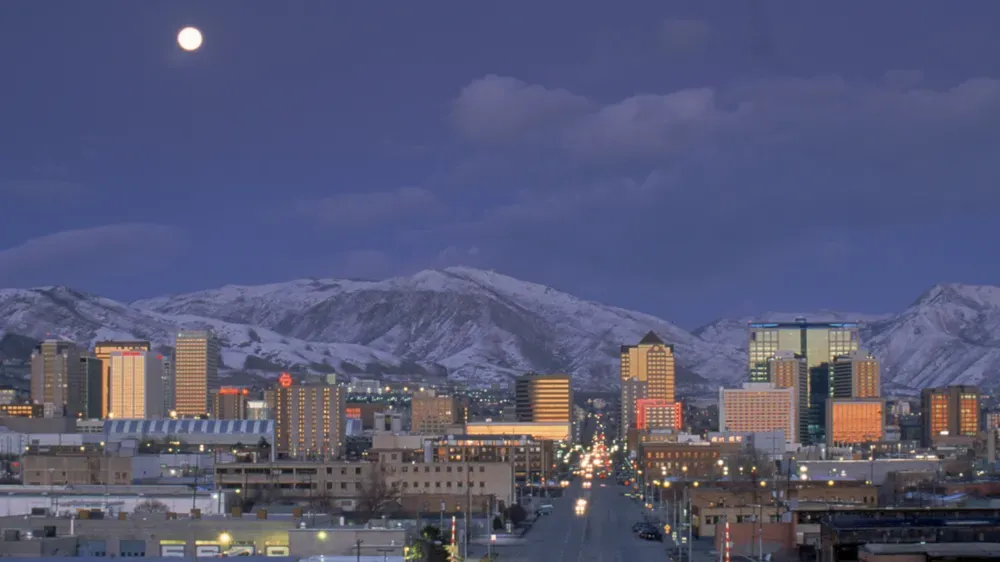
SALT LAKE CITY, UT - FEBRUARY 18: A general view of the Salt Lake City skyline taken during the 2002 Winter Olympic Games on February 18, 2002 in Salt Lake CIty, Utah. Photo Credit: ( Photo by: Brian Bahr/Getty Images)
Salt Lake City, Utah, is emerging as an unexpected haven for LGBTQ+ travelers, offering a thriving queer community, progressive local culture, and close proximity to world-class outdoor adventures. and breathtaking landscapes, Salt Lake City invites LGBTQ+ vi
Salt Lake City, long known for its religious roots and stunning mountain backdrop, is rapidly gaining recognition as one of North America’s most welcoming and vibrant destinations for LGBTQ+ travelers. Over the past decade, the city has seen a steady rise in queer visibility, progressive leadership, and inclusive spaces, making it a standout for those seeking a travel experience that blends community, culture, and adventure .
At the heart of Salt Lake City’s queer renaissance is its engaged and visible LGBTQ+ community. The city hosts a bustling Pride celebration each June, drawing thousands of locals and visitors for a week of parades, performances, and solidarity. This vibrant event, centered downtown, has become one of the largest in the region and reflects the city’s growing spirit of inclusion .
The city’s commitment to LGBTQ+ rights is mirrored in its political history. Jackie Biskupski, who served as mayor from 2016 through 2020, was the first openly lesbian mayor of Salt Lake City—a testament to the city’s evolving values and diverse leadership . Today, queer-owned and queer-friendly businesses flourish, from energetic nightspots like Milk+ and Club Try-Angles to cozy, colorful cafés and boutiques sprinkled throughout neighborhoods such as the Marmalade District and Sugar House.
Salt Lake City’s appeal goes beyond its city streets. As a major hub for Delta Air Lines, it is easily accessible, and serves as a gateway to Utah’s iconic ski resorts—Brighton, Solitude, Alta, Snowbird, Deer Valley, and Park City Mountain—all less than an hour’s drive from downtown . Each February, the city and surrounding mountains host Utah Gay Ski Week, an inclusive event drawing skiers and snowboarders from across the country for slopeside parties, drag shows, and community-building activities .
The city’s hospitality sector has embraced its identity as a queer-friendly destination. The Kimpton Hotel Monaco Salt Lake, for example, is celebrated for its whimsical decor, central location, and outstanding dining at Bambara. It’s steps from the Gateway shopping center and leafy Pioneer Park, and offers easy access to the city’s cultural and nightlife highlights .
Salt Lake City’s LGBTQ+ calendar is robust. Beyond Pride and Ski Week, the city is home to film festivals, art fairs, and queer-led community gatherings year-round. Local organizations and advocacy groups, such as the Utah Pride Center, provide resources and programming for both residents and visitors, ensuring that transgender people, nonbinary individuals, and all LGBTQ+ identities feel seen and supported throughout their stay .
The city’s landscape encourages exploration and connection. Outdoor enthusiasts can hike or bike along scenic foothill trails, paddleboard on the Great Salt Lake, or simply unwind in one of the city’s many public parks. This blend of urban vibrancy and natural beauty is drawing increasing numbers of queer visitors looking for a destination that is both affirming and adventurous .
Salt Lake City’s ascent as a queer-friendly travel destination is notable in a region not always associated with progressive values. The city’s engaged LGBTQ+ community, visible leadership, and commitment to inclusivity set it apart from more traditional queer hotspots . For travelers seeking a welcoming environment, unique events, and easy access to the outdoors—all without the crowds of coastal metropolises—Salt Lake City offers an experience that is both unexpected and unforgettable.
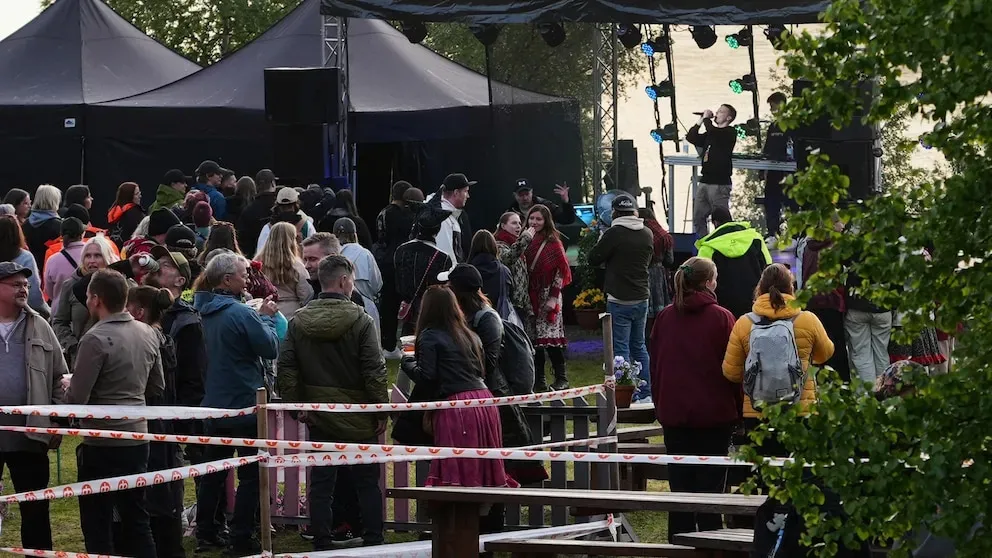
Artist Yungmiqu performs at the Loktafeasta rap festival in Utsjoki village, north of the Arctic circle, Finland, Sunday, July 6, 2025. Photo Credit: (AP Photo/Tommi Ojala)
A music festival in Utsjoki, Finland, brings Sámi culture to the spotlight under the midnight sun
UTSJOKI, Finland (AP) — It was well past midnight when Mihkku Laiti appeared on stage to perform at an open-air music festival in the Finnish village of Utsjoki, north of the Arctic circle.
Despite the time, Lapland’s famous midnight sun was still up. During the summer months the sun doesn’t go down at all in Utsjoki, which is less than 50 kilometers (30 miles) from the Arctic Ocean.
In the glow of blue spotlights, Laiti rapped while a crowd of more than 300 listened, some of them singing along and dancing. Like the majority of Utsjoki’s residents, Laiti is a member of the Sámi — Europe's only recognized Indigenous people — and he rapped in his native Sámi language.
Laiti, also known by his stage name “Yungmiqu,” is the founder of the Loktafeasta rap festival. He first found fame on the television show Talent Finland, where he surprised the judges by rapping in the gákti, the traditional dress of the Sámi. It is brightly colored and often characterized by plaits, pewter embroidery and a high collar.
The festival brought Laiti’s Indigenous culture to the spotlight, though some of his fans could not understand what he was saying. That didn’t seem to bother anyone at the Loktafeasta as the festival mixed performances from artists in both Sámi language and Finnish.
Some drank beer and ate sausages and the crowd seemed to enjoy the summer festival atmosphere despite spells of rain.
“When I rap about my culture ... I want to show how being Sámi is like from my point of view," Laiti told The Associated Press.
“Because there are many stereotypes about Sámi people and I want to like normalize ... the basic stuff we do and not romanticize those things,” he said. He added that he has not worn the gákti for performances for about a year now to show people that it is possible to be Sámi and wear whatever you want.
Europe's only recognized indigenous people
The Sámi traditionally live in Lapland, which stretches from northern parts of Norway to Sweden and Finland to Russia. However, of the roughly 10,000 Sámi people living in Finland, the majority now live outside their homeland.
The Sámi people were oppressed for centuries by the powers that ruled and exploited their lands, including bans of the use of their native tongues and efforts to suppress their culture. In the past decades, there have been efforts to reestablish their rights, including the right to use Sámi languages which is now guaranteed in the Finnish constitution.
Today, the historically semi-nomadic Sámi people have modern lifestyles. The few who still tend reindeer do so with modern vehicles, digital tools and regulated land use.
However, there is an effort to preserve the Sámi's cultural identity. Distinctive Sámi clothing was worn by many at Loktafeasta, as is typical on special occasions.
Artists rap in Finnish and Sámi language
At the festival, Laiti mostly wanted his fans to be happy and enjoy the music.
“I want people to feel joy, of course, and I just want people to be happy that we have this kind of festival here in Utsjoki," he said with a smile.
Among the other acts was a duo comprised of self-confessed old school tango crooner Jaakko Laitinen and rapper Jouni J. They also reside in Lapland and perform in Finnish.
“I see a connection from the hip hop and the tinkering with words to the old Finnish like Kalevala freestyling folk poetry," said Laitinen, referring to Finland's national epic about the Earth's creation.
"So that obvious connection and the Finnish tango ... is part of our soul and heart,” he added.
A world away from the birthplace of rap music in the Bronx
Although the duo’s songs were a world away from the birthplace of rap music in the Bronx in New York City, their performance brought joy to Utsjoki's locals and visitors.
“Music travels and music brings people together. It’s the magic of the international language of music,” Laitinen said.
by Heli Sivunen
Copyright Associated Press. All rights reserved. This material may not be published, broadcast, rewritten, or redistributed.
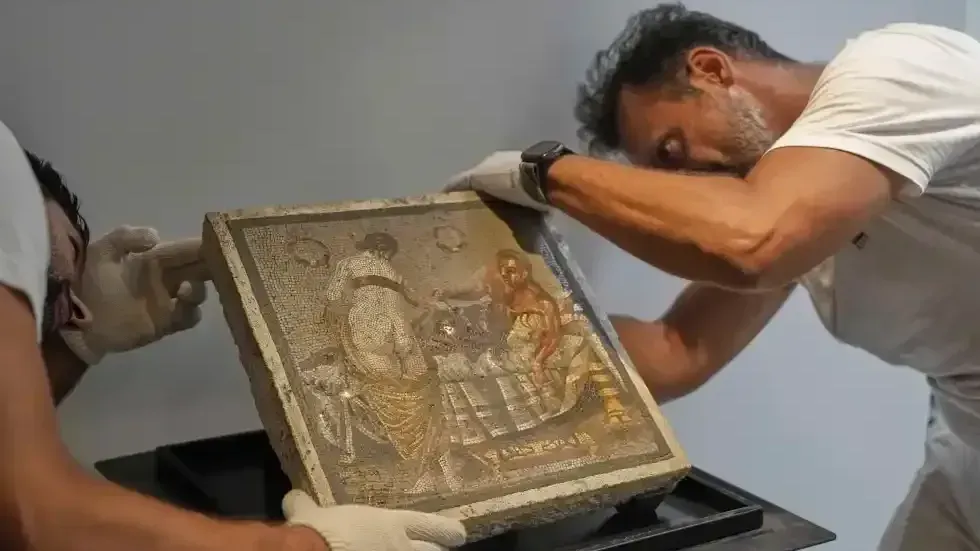
Restorers set on display a Roman mosaic depicting a pair of lovers, which was repatriated from Germany, in Pompeii archaeological park, Italy, Tuesday, July 15, 2025. Photo Credit: (AP Photo/Gregorio Borgia)
An mosaic panel on travertine slabs depicting an erotic theme from the Roman era has been returned to the archaeological park of Pompeii after being stolen by a Nazi German captain during World War II
POMPEII, Italy (AP) — A mosaic panel on travertine slabs, depicting an erotic theme from the Roman era, was returned to the archaeological park of Pompeii on Tuesday, after being stolen by a Nazi German captain during World War II.
The artwork was repatriated from Germany through diplomatic channels, arranged by the Italian Consulate in Stuttgart, Germany, after having been returned from the heirs of the last owner, a deceased German citizen.
The owner had received the mosaic as a gift from a Wehrmacht captain, assigned to the military supply chain in Italy during the war.
The mosaic — dating between mid- to last century B.C. and the first century — is considered a work of “extraordinary cultural interest,” experts said.
“It is the moment when the theme of domestic love becomes an artistic subject,” said Gabriel Zuchtriegel, director of the Archaeological Park of Pompeii and co-author of an essay dedicated to the returned work. “While the Hellenistic period, from the fourth to the first century B.C., exulted the passion of mythological and heroic figures, now we see a new theme."
The heirs of the mosaic's last owner in Germany contacted the Carabinieri unit in Rome that's dedicated to protecting cultural heritage, which was in charge of the investigation, asking for information on how to return the mosaic to the Italian state. Authorities carried out the necessary checks to establish its authenticity and provenance, and then worked to repatriate the mosaic in September 2023.
The collaboration with the Archaeological Park of Pompeii was also key, as it made it possible to trace it to near the Mount Vesuvius volcano, despite the scarcity of data on the original context of its discovery, the Carabinieri said.
The panel was then assigned to the Archaeological Park of Pompeii where, suitably catalogued, it will be protected and available for educational and research purposes.
“Today’s return is like healing an open wound,” Zuchtriegel said, adding that the mosaic allows to reconstruct the story of that period, the first century A.D., before Pompeii was destroyed by the Vesuvius eruption in A.D. 79.
The park’s director also highlighted how the return by the heirs of its owner signals an important change in “mentality,” as “the sense of possession (of stolen art) becomes a heavy burden.”
“We see that often in the many letters we receive from people who may have stolen just a stone, to bring home a piece of Pompeii,” Zuchtriegel said.
He recalled the so-called “Pompeii curse,” which according to a popular superstition hits whoever steals artifacts in Pompeii.
The world-known legend suggests that those who steal finds from the ancient city of Pompeii will experience bad luck or misfortune. That has been fueled over the years by several tourists who return stolen items, claiming they brought them bad luck and caused tragic events.
___
Zampano reported from Rome.
by Giada Zampano and Andrea Rosa
Copyright Associated Press. All rights reserved. This material may not be published, broadcast, rewritten, or redistributed.