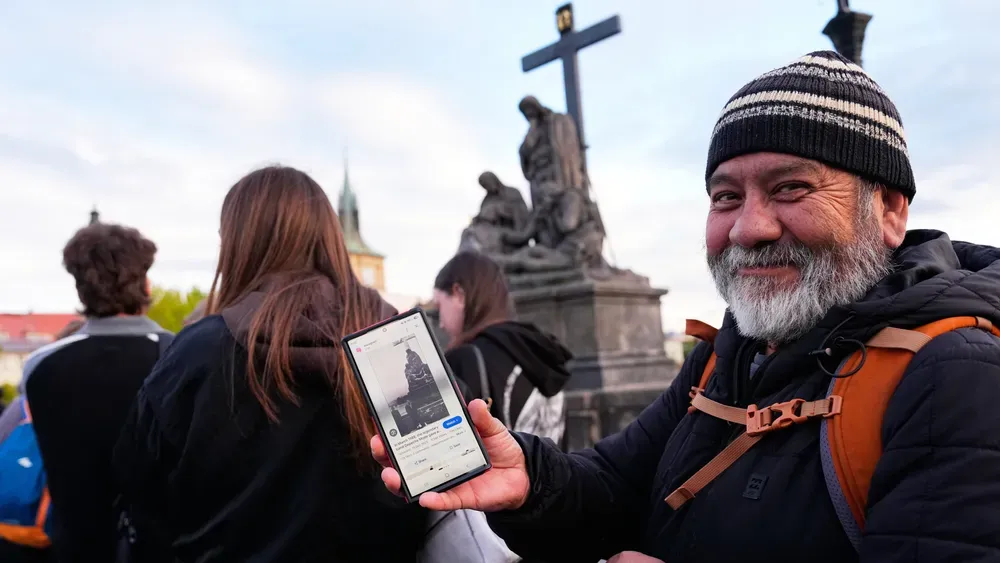
Jorge Sanchez from Los Angeles displays a famous photo of two members of Depeche Mode, taken by Dutch photographer Anton Corbijn in 1988, as he waits in line to recreate this image by the Pieta statue at the Charles Bridge in Prague, Czech Republic, Thursday, Sept. 24, 2026. Photo Credit: AP Photo/Petr David Josek
A new trend has emerged at Prague's Charles Bridge, where tourists now line up to recreate a famous photo of the members of Depeche Mode
A constant eye-catching queue that forms daily at a sculpture on Prague 's Charles Bridge has become a new feature of the 14th-century landmark.
Tourists have long flocked to the bridge over the Vltava River to visit the statue of St John of Nepomuk. Now, visitors are lining up at the nearby Pietà sculpture to recreate an iconic 1988 photograph of music icons Depeche Mode.
The British electro-rock band first crossed the Iron Curtain in March 1988 to play a historic concert in Prague, then the capital of communist Czechoslovakia. They returned that November with renowned Dutch photographer Anton Corbijn, who captured them exploring the city for photographs that later appeared in his book, “Depeche Mode: Strangers.”
One black-and-white image has a particular appeal for fans: Dave Gahan and Martin Gore standing beside the Pietà sculpture.
Fans have been making the pilgrimage for years, but photographs of a mass gathering on the bridge between the band’s Prague concerts in 2024 appear to have helped fuel a modern-day boom.
Currently, the photo recreated by the visiting fans is trending with millions of views on social media.
Jorge Sanchez, from California, and his wife were among the recent visitors.
“Well, I remember seeing the picture from way back, and then I kind of remember, and I looked it up, and I learned that it was here, so I wanted to make sure I took a picture,” Sanchez said.
“I think it fit at the time, you know, with their music, you know, and their message and their music with your personal Jesus and all of that, so it’s kind of fitting.”
Maria Hofer and Lara Hinteregger came from Austria.
“We just saw this on Pinterest or on TikTok, and it’s kind of one of the most famous pictures you can take here in Prague,” Hofer said. “So, we wanted to do it as well,” Hofer said.
“Yeah, and we also like the vibe of the music. We feel like it fits the vibe of the city pretty well,” Hinteregger added.
St John Nepomuk was tortured to death at the request of King Wenceslas IV in 1393 because he refused to violate the seal of the confession and reveal to him the sins of his wife. His dead body was thrown into the river from Charles Bridge.
It is said that touching the polished engravings of the event placed at the pedestal of the Nepomuk statue will bring luck and ensure a return to Prague.
It is not clear if the members of Depeche Mode placed their hands on the Nepomuk statue in March 1988, but they returned later that same year — and their photographs have given fans another reason to follow.
by Karel Janicek
Copyright Associated Press. All rights reserved. This material may not be published, broadcast, rewritten, or redistributed.
Travelers could be stuck paying high airfares even if oil and jet fuel prices fall
Travelers could be stuck paying high airfares even if oil and jet fuel prices fall, major U.S. airlines and industry analysts say.
The price of jet fuel shot up after the Iran war began and retreated sharply in the spring before surging again as the summer went on. Such fluctuations make it harder for airlines to plan ahead and give them a reason to be cautious about lowering ticket prices, according to Brett House, an economist who teaches at Columbia Business School.
Jet fuel has risen even faster than oil during the war, reflecting both higher crude prices and tight supplies of the refined fuel that is one of airlines’ largest operating expenses. Carriers cut some less profitable flights and raised fares and baggage fees, although major U.S. airlines said higher passenger revenue initially covered only part of their soaring fuel costs.
Airfares haven’t moved in lockstep with fuel prices, however. The Argus U.S. Jet Fuel Index plunged from an early April peak of $4.88 a gallon to a wartime low of $2.70 in June, but average fares remained elevated.
The average fare, not including optional fees for services such as checked bags and seat selection, rose from $405 in the last three months of 2025 to $428 in the first quarter of this year and to $436 in the April-June period, according to the Bureau of Transportation Statistics.
Part of the disconnect between fuel prices and airfares comes down to timing, House said. Airlines typically decide several months in advance how many flights to operate and seats to offer, factoring in expected fuel costs and other expenses. They begin selling tickets even earlier. While prices for seats on the same flight can change repeatedly, airlines can't charge more for seats already sold if fuel prices suddenly spike, he explained.
“It’s not just the level of fuel costs that is a problem or a challenge for airlines,” House said. “It’s also the volatility.”
There are few signs of relief so far for travelers as airlines adjust their schedules and prices for the remainder of the year. In August, U.S. airfares were 23% higher than a year earlier, according to the Labor Department. Jet fuel prices kept climbing this month, reaching $4.53 a gallon on Sept. 17, according to the Argus index.
At $4.30 a gallon on Friday, the average price across the four U.S. markets the index tracks remained nearly twice the 2025 average. Travelers shopping for holiday flights already are encountering the highest airfares in a decade, travel-booking company Hopper said in a report published the same day.
The company, which tracks fares available in flight searches, estimated that during the previous week, a round-trip domestic fare averaged $402 for Thanksgiving travel and $452 for Christmas, 31% and 23% more than last year.
And the pressure on airlines and travelers isn't limited to the United States. Globally, jet fuel averaged about $99 a barrel on Feb. 27, the day before the war began, according to the International Air Transport Association’s Jet Fuel Price Monitor. Prices more than doubled to $209 by early April, fell for nearly three months and reached $195 a barrel in mid-September following their renewed ascent, IATA said, citing data from S&P Global Energy Platts.
Fuel prices can swing overnight while airfares decline more slowly
The renewed pressure on jet fuel prices stems from many of the same disruptions that have sent diesel prices soaring. Fighting has curtailed refinery production and fuel exports from the Middle East, while Ukrainian strikes have damaged Russian refineries. Because diesel and jet fuel are closely related products that compete for refinery output, shortages of one can put additional pressure on the price and availability of the other.
IATA expects fuel to account for nearly one-third of airline operating expenses this year, up from about a quarter in 2025.
By the time fuel prices jumped again, about 35% of United’s tickets for the final three months of the year were already booked and the airline could not increase those fares retroactively, Chief Financial Officer Mike Leskinen said. The airline expects to recover its higher fuel costs through revenue but not immediately, he said.
Speaking about the rising price of jet fuel at a Sept. 16 investor conference, Leskinen said, “I don’t actually care if it stays high. I just need it to stabilize.”
The time it takes airlines to recoup their costs means travelers may keep paying for a fuel spike even as prices come down. Jet fuel prices need to fall and stay down for airfares to decline on a sustained basis, said Stephen Treanor, a finance professor at California State University, Chico, who has studied airlines’ exposure to fuel price risk.
Carriers are responding to the latest swing in fuel prices
The speed with which jet fuel prices rose recently has complicated the forecasts of U.S. airlines. As recently as Sept. 10, JetBlue raised its expected average fuel price for the July-September period to $3.96 a gallon. Prices continued climbing afterward, with the Argus U.S. Jet Fuel Index reaching $4.53 a gallon a week later and remaining above $4.25 with just days left in the quarter.
Every penny per gallon adds about $10 million to American Airlines' quarterly fuel bill, Chief Financial Officer Devon May said. Speaking at the same investor conference this month, May said the latest increases would boost the airline's fourth-quarter fuel costs by about $1 billion.
American, United and Southwest Airlines have said they are pruning their flight schedules further, particularly on less-profitable routes, due to higher fuel costs. United, for example, pulled some December flights and warned of further cuts in 2027 if fuel remains expensive. American said it expected to grow more slowly next year than it anticipated a few months ago.
Travelers who buy tickets at the last minute are paying a price. The average same-day fare for a one-way domestic Allegiant Air flight jumped 21% in a week, to $280 on Sept. 18, according to a Deutsche Bank analysis of flight pricing. The comparable price for a same-day American Airlines fare was $463, up 6%.
For travelers holding out for cheaper fares, the wait could outlast the war itself.
“The likelihood that fuel surcharges are going to be rolled back and airfares are going to be brought down is very low over the next few months,” House said.
by Rio Yamat
Copyright Associated Press. All rights reserved. This material may not be published, broadcast, rewritten, or redistributed.
Residents on Hawaii’s Big Island are bracing for potentially life-threatening and catastrophic flooding from Hurricane Nolo
HILO, Hawaii (AP) — People on Hawaii’s Big Island are preparing for another potentially life-threatening and catastrophic storm as Hurricane Nolo is expected to bring flash floods and extreme surf as it churns just south of the islands through the weekend.
Nolo was expected to strengthen to a major hurricane on Saturday. Its maximum sustained winds increased to 105 mph (165 kph) Friday. The storm’s center was located about 185 miles (300 kilometers) south of Hawaii’s southernmost point.
Forecasters warned parts of the Big Island could see rainfall totals up to 15 inches (38 centimeters), with a possibility of up to 25 inches (64 centimeters). That was down from an earlier forecast that called for up to 35 inches (89 centimeters).
“People are going to want to kind of shelter in place on the Big Island, be in their safe place, certainly by later today, tonight, well into Saturday," Michael Brennan, director of the National Hurricane Center, said Friday. “Don’t venture out if you don’t have to into the dangerous flooding environment, but also high winds. We can have trees and power lines down.”
Heavy rainfall also was possible on Hawaii's other islands, the hurricane center said. Maui also could see heavy rainfall and potential life-threatening flooding and mudslides, forecasters said.
Crews on the Big Island spent hours Friday trying to build berms to guide water and move large debris ahead of the worst of the rain, said Erika Kapu, Hawaii program manager for the humanitarian nonprofit CORE.
CORE and other nonprofit partners spent the week packing and shipping supplies like camp stoves and hygiene products by air cargo from Oahu to the Big Island for a community relief hub that has been active since August's Hurricane Lala.
Hawaii prepares as northern edge of Nolo is expected to barrel through
President Donald Trump on Friday approved an emergency declaration for the state of Hawaii, authorizing the Federal Emergency Management Agency to coordinate assistance from across the federal government and provide funding support for emergency measures.
Hawaii officials told residents to put together emergency kits, and the governor issued an emergency proclamation, activating more than 230 Hawaii National Guard members. Schools were closed in some areas.
Hawaii County officials on the Big Island were urging residents in flood-prone areas to consider taking refuge at shelters being set up or other locations.
The heaviest rain from Nolo is likely to fall over the same southeastern region of the Big Island that was hit by Lala and where grounds are still wet from additional precipitation. The storm surge could hit 1 to 3 feet (30 to 91 centimeters), creating large and dangerous waves and coastal flooding, the hurricane center said.
Hawaiian Electric, the state’s primary utility, said crews that had been helping restore power in Kauai after this month’s Hurricane Lowell would return to Oahu, Maui and the Big Island in preparation for the coming storm.
Residents and tourists on the Big Island were busy preparing.
In Hilo, where light rain was falling Friday, residents filled bags with sand and gravel at Francis Wong Stadium, where authorities set up a sand distribution center.
Dean Taise said water was starting to get into his driveway from the street, so he decided to get a few sandbags ready ahead of possible floods.
“They say, prepare for the worst, right? Hope for the best,” Taise said.
Piles of sandbags lined the terminal at Hilo International Airport, where Daniela Mendoza was trying to get home to Oahu after Southwest Airlines canceled flights. Only Hawaiian Airlines was still flying out of the airport Friday afternoon.
“I hope I can leave,” Mendoza said. “My cats are waiting for me.”
Polo is strengthening after returning to Category 5 intensity
Meanwhile, Mexico is under the threat of Hurricane Polo as it heads toward the Baja California peninsula after bringing storm conditions to the southwestern coast.
The hurricane center said Polo gained significant force overnight into Friday morning and doused parts of Mexico's Pacific Coast. No major damage or flooding was reported along the coast overnight into Friday.
By midday Friday, attention turned to the peninsula, where the hurricane was slated to arch back and hit between Monday and Tuesday. Local authorities were preparing shelters, and Mexico’s government announced Friday afternoon that they were closing ports in the region as dark clouds swirled overhead.
The latest estimated sustained winds were 180 mph (290 kph).
Residents stacked sandbags to fortify beachfront shops and evacuated their homes in some coastal areas on Thursday. Mexican authorities opened shelters and cleared people from beaches, and 15,000 security personnel were deployed across the coast. Schools were closed.
In the port city of Lázaro Cárdenas in Michoacán, seawater swept through homes and left wooden planks and furniture strewn on the streets. Locals and government officials were clearing debris and shoveling thick mud coating much of the town.
Alicia Contreras said the walls and roof of her restaurant had been severely damaged by 15-foot (4.5-meter) waves. She worried about how she would recover economically, saying she has no other source of income.
Brennan said some moisture associated with Polo will be pushed into parts of the southwestern U.S. by Monday, possibly producing scattered flash flooding in the Four Corners region, particularly portions of Arizona and New Mexico.
Biologists on Friday relocated eggs from two olive ridley sea turtle nests on Southern California beaches to the Aquarium of the Pacific in Long Beach over concern about high tides and hazardous surf as officials monitor Hurricane Polo.
Powerful storms come during the weather phenomenon El Niño
A third storm in the Pacific, Hurricane Odalys, was at Category 4 status and was still far from land Friday, roughly 955 miles (1,537 kilometers) west-southwest of the southern tip of the Baja California peninsula.
Two other powerful storms were churning in the Atlantic Ocean but were not near land.
In the northern Atlantic, Tropical Storm Fay reformed early Thursday. As of Friday, it was about 1,040 miles (1,674 kilometers) west-southwest of the Azores, the hurricane center said. Off Africa's western coast, Tropical Storm Gonzalo strengthened early Friday as it approached the Cabo Verde Islands.
___
Associated Press reporters Dave Collins in Hartford, Connecticut; Gabriela Aoun Angueira in San Diego; Kathy McCormack in Concord, New Hampshire; and Hannah Schoenbaum in Salt Lake City contributed.
by Eugene Garcia
Copyright Associated Press. All rights reserved. This material may not be published, broadcast, rewritten, or redistributed.
Bethpage, Tennessee, a community of roughly 300 people, became the setting for the fourth annual Affirming Sumner Pride Festival on September 19.
For travelers seeking LGBTQ+ community beyond the usual Pride capitals, Bethpage, Tennessee, offers an unusually intimate destination: a rural community where a queer-owned farm has become a gathering place for affirmation, creativity, and local connection.
The community is in Sumner County, approximately 45 minutes from Nashville, and has a population of only a few hundred people. Data Commons lists Bethpage’s 2024 population as 289, while the 2020 census count was 313.
That scale is central to the story. Bethpage is not a conventional LGBTQ+ tourism hub with a concentrated nightlife district or a long-established commercial Pride organization. Instead, its emerging queer visibility is being built through personal initiative, local partnerships, and a farm that has opened its gates to people who want to celebrate LGBTQ+ lives in a rural setting.
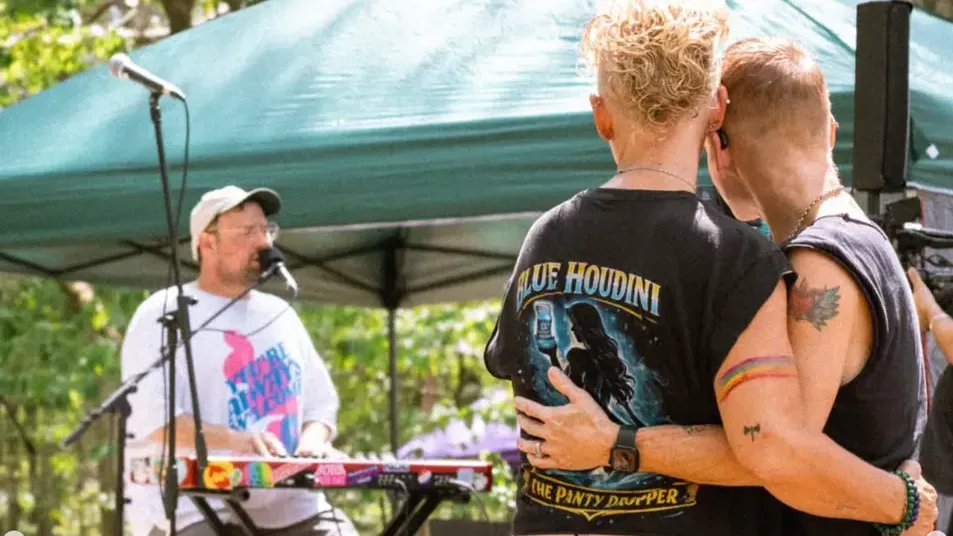
The latest sign of that change arrived on September 19th, when Fruity Farm hosted the fourth annual Affirming Sumner Pride Festival. The free, family-friendly event was organized as a picnic and celebration of diversity, inclusion, and love in Sumner County.
From a missing Pride event to a community tradition
The festival grew from a practical problem: Sumner County did not have a Pride event planned for the year. MORGXN and his husband, Gabriel Starner, responded by making their own property available for the community.
According to reporting by The Tennessean, local businesses and venues had withdrawn from hosting a Pride celebration after facing online threats. Fruity Farm consequently became the site of Affirming Sumner, providing a private and welcoming location for the event.
The decision reflects one of the most important ways LGBTQ+ inclusion develops in smaller communities: not always through a large institution, but through people creating dependable spaces when existing venues are unavailable. In this case, the hosts’ home and farm became a place where LGBTQ+ people, families, allies, artists, and small businesses could gather publicly.
The event’s organizers also built on work that had already begun locally. MORGXN wrote that Affirming Sumner had been started by Emma Holland of The Collab in Hendersonville and Emma Frost and Lauren Niceley, co-owners of Earth First Plant Co & Vintage in Gallatin, with support from PFLAG Hendersonville.
That background matters for visitors. Affirming Sumner is not simply an entertainment event attached to a celebrity host; it is part of a developing regional network connecting queer-owned and queer-supportive businesses, organizers, and community groups across Sumner County.
What visitors found at Fruity Farm
The 2026 festival brought LGBTQ+ musical performances, more than 30 local vendors, and hands-on activities including painting and bracelet-making, according to The Tennessean. Nearly 1,000 people RSVP’d, a striking turnout for an event held in a community of approximately 300 residents.
The festival’s format offers a different kind of LGBTQ+ travel experience from a downtown bar crawl or a major parade. Visitors encounter a farm landscape, local makers, live music, family-oriented activities, and a community event whose purpose is as much relationship-building as celebration.
That combination also makes Bethpage a useful base for travelers who want to pair rural LGBTQ+ community with Nashville’s larger cultural scene. The festival site is close enough to Nashville for a day trip, while remaining distinctly separate from the city’s established entertainment economy. The Tennessean described Fruity Farm as a 24-acre agroforestry property, giving the event a setting that is agricultural and residential rather than convention-centered.
Travelers should note that Fruity Farm is not presented as a walk-in tourist attraction. The festival organizers advised attendees to RSVP for the address, warned that parking was limited, and described the site as an outdoor setting with gravel and grass. Visitors considering future events should check the official Affirming Sumner and Fruity Farm channels for access, mobility, parking, weather, and safety information before traveling.
Why Bethpage is worth watching now
Bethpage’s LGBTQ+ visibility is still emerging, and it would be inaccurate to describe the community as uniformly inclusive. The available reporting documents a specific event and a growing network of organizers; it does not establish that every local institution or business shares the same position. The evidence does show, however, that queer people and allies are creating a public presence in a place where a formal Pride celebration might otherwise have disappeared from the calendar.
Fruity Farm itself is part of that cultural shift. The farm is run by MORGXN and Gabriel Starner, and the couple have described it as a home for both agriculture and community. The Advocate reported that the pair bought land outside Nashville, launched Fruity Farm, and used the property to build community after returning to the Nashville area.
The farm also gives visitors a direct way to support LGBTQ+-owned enterprise. Fruity Farm’s online shop identifies Gabriel Starner and Morgan Karr as the married team behind the business and offers plants and related products through Fruity Farm TN on Etsy.
For an LGBTQ+ traveler, that is the appeal of Bethpage right now: the destination is small, personal, and still being made. A visit is not about consuming a finished “gayborhood.” It is about showing up for a rural community event, purchasing from local vendors, listening to queer performers, and recognizing the people building belonging where public LGBTQ+ space has not always been easy to sustain.
Affirming Sumner’s 2026 festival has now concluded, but the event’s recent success gives travelers a reason to follow future announcements from Affirming Sumner, Fruity Farm TN , and regional LGBTQ+ organizations such as PFLAG Hendersonville. The festival’s organizers have demonstrated that, in a community of only a few hundred people, a queer-owned farm can become a meaningful destination—and that a Pride tradition can begin with an open gate, a local partnership, and a willingness to make room.
by Chris Tremblay
Copyright EDGE Media Network. All rights reserved. This material may not be published, broadcast, rewritten, or redistributed.
Austin’s inaugural Big Queer Weekend begins Thursday, 2026-09-24, bringing together LGBTQ+ film, music, visual art, drag and community gatherings across four days.
Austin’s inaugural Big Queer Weekendopens Thursday, September 24th, presenting four days of LGBTQ+ film, music, drag, visual art and community events. Organized through a partnership involving the Austin LGBT Chamber of Commerce, aGLIFF—Austin’s LGBTQ+ Film Festival, SXSW and Pride in Local Music, the weekend is scheduled across several Austin venues through Sunday, September 27, 2026.
The event is notable because it treats queer cultural life as a connected ecosystem rather than a single-night entertainment program. Its schedule places film screenings beside live music, drag performance, an artist and artisan marketplace, filmmaker conversations and a gathering for queer creatives. The organizers describe the weekend as a celebration of LGBTQ+ film, music, art and community.
Opening night and film program
Opening night begins at Galaxy Theatres Austin with a red-carpet reception and the Southwest premiere of "Lady Champagne", a comedy from drag performer and filmmaker D’Arcy Drollinger. The program also includes Margaret Barry’s short documentary "The Best Little Tiny Park in Texas", followed by an official after-party at Rain on 4th featuring filmmakers, special guests and performers.
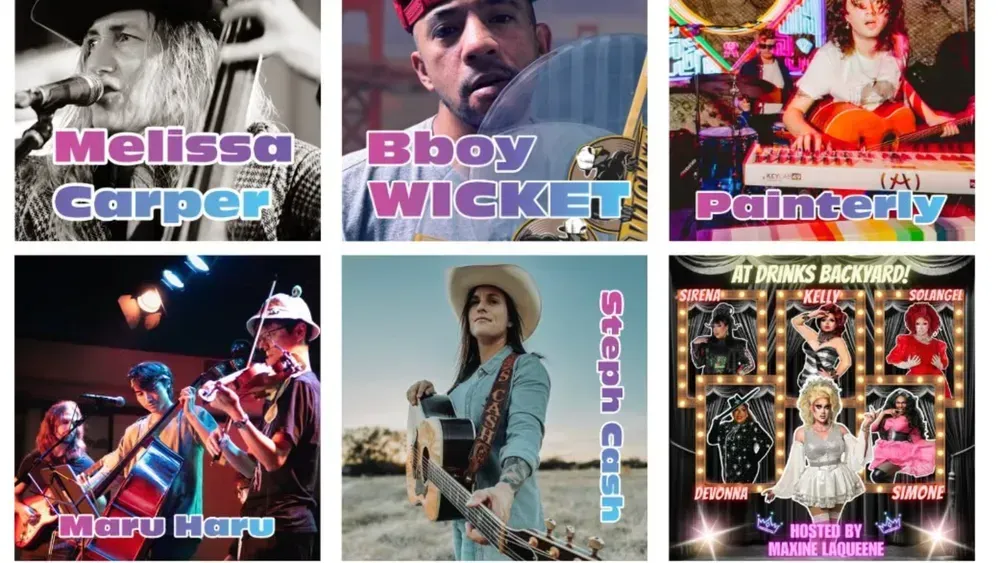
Galaxy Theatres Austin is serving as the central film venue for the weekend’s six feature films and filmmaker question-and-answer sessions. The schedule includes "This Is Texas: AGMC’s Journey to GALA", "The Dads", "Give Me the Ball!", "Out Laws", "Assembly" and "WICKET".
The films approach queer life through different forms of storytelling. "The Dads", directed by Emmy Award-winning filmmaker Luchina Fisher, is paired with a moderated community conversation. "Give Me the Ball!" examines the life of tennis legend Billie Jean King, while "Out Laws" addresses the international history of anti-LGBTQ+ legislation. "Assembly", presented through aGLIFF’s Queer Black Voices initiative, is connected to artist Rashaad Newsome’s work.
The inclusion of "WICKET" gives the weekend a direct connection to Austin’s dance and music communities. The documentary features Gabriel “Bboy Wicket” Jaochico, an Austin resident and internationally recognized breaker, DJ and educator. Jaochico is scheduled to appear with filmmaker Lily Plotkin for the festival’s closing-night conversation.
Gabriel “Bboy Wicket” Jaochico and the politics of the dance floor
Jaochico is the featured queer performer highlighted by the weekend’s programming. His participation demonstrates how breaking, DJ culture and live conversation can function as forms of queer cultural memory, particularly when artists are presented not only as entertainers but also as people whose creative practices are part of a local community’s history. The available event materials identify Jaochico as a breaker, DJ and educator and confirm his scheduled closing-night appearance.
The weekend’s organizers have also placed Jaochico within the live music and performance program. A separate Pride in Local Music announcement describes the Saturday showcase as an event for Austin’s LGBTQ+ musicians, drag performers, artists and makers, with Jaochico included among the performers.
His role is significant because the program does not isolate queer performance from the rest of the weekend’s cultural activity. Instead, a dancer and DJ appears in both the documentary and live-event portions of the schedule. That structure reflects the way queer nightlife and community rituals frequently overlap: a film screening can lead into a discussion, a showcase can become a marketplace, and a DJ set can share space with drag, local art and informal social connection. The organizers’ published schedule supports those connections, while broader interpretations of their cultural meaning are analytical rather than direct quotations from the organizers.
Pride in Local Music
The weekend’s most direct live-performance event is the seventh annual Pride in Local Music Showcase and Queer Artist Marketplace, scheduled for Saturday, September 26, at Drinks Backyard. The event is free and open to the public, although advance online registration is encouraged.
Drinks Backyard is described as an open-air setting for local queer bands, DJs, drag hosts and an artist and artisan marketplace. The venue is located at 6328 South Highway 183 in Austin, and the event includes food trucks, a full bar and a dog-friendly outdoor area.
Maxine LaQueene and Friends are scheduled to host the Saturday showcase, which combines live music and drag with opportunities to browse work by local artists and makers. The arrangement gives the event a community-market dimension: attendees are not only watching performances but also encountering creative work and participating in a public queer gathering.
That format also distinguishes Pride in Local Music from a conventional concert. The program makes room for artists whose practices may move between music, dance, fashion, visual art and performance. It creates a setting in which community members can encounter queer expression through several mediums in one place, without requiring a single definition of what a queer artist or performer should be. The event materials document the lineup format and marketplace; the broader cultural interpretation is .
A weekend built around gathering
Other scheduled events include a Big Queer Creatives Brunch and pool gathering at Hotel Indigo Austin Downtown on Sunday, September 27. The brunch is intended to bring together local filmmakers, musicians, artists and other creatives.
The weekend’s venues create a geographic circuit linking a cinema, a downtown nightlife location, an outdoor performance space and a hotel gathering. Galaxy Theatres Austin is the film headquarters; Rain on 4th hosts the opening-night after-party; Drinks Backyard hosts the music, drag and art showcase; and Hotel Indigo hosts the closing creative mixer and brunch.
Organizers are offering a $50 weekend pass, while the Saturday Pride in Local Music event is free. The published schedule therefore includes both ticketed and public-access elements.
As Austin’s Big Queer Weekend begins, its clearest news value lies in the scale and range of the collaboration: LGBTQ+ film organizations, a business chamber, a major cultural institution and a local music program are presenting one weekend that moves between cinema, nightlife, drag, dance, music and visual art. Jaochico’s participation provides a particularly visible example of that crossover, placing a queer performer’s work at the center of both a documentary conversation and a live community showcase.
Dallas’ LGBTQ+ community gathered on September 20, 2026, for the Pride in Dallas parade on Cedar Springs Road, the culmination of an eight-day celebration in the Oak Lawn neighborhood.
Dallas’ LGBTQ+ community concluded its 2026 Pride in Dallas week on Sunday, September 20, with a parade along Cedar Springs Road in Oak Lawn, a neighborhood widely associated with LGBTQ+ life in the city. The parade began at 2 p.m. and served as the closing event of an eight-day schedule organized around Cedar Springs and the surrounding Oak Lawn area.
The celebration’s official theme was “Pride Lives Here.” Pride in Dallas described the parade as a grassroots event on the Strip, with the route running along Cedar Springs Road through Oak Lawn. The event was free to attend, and the organization encouraged spectators to arrive before the parade’s 2 p.m. start.
The parade was presented as the fifth anniversary celebration under the management of Pride in Dallas. Its 2026 name, the Michael Doughman Pride Parade, honored Michael Doughman, a longtime Dallas LGBTQ+ community organizer and parade executive director who passed away in 2019. Dallas Voice reported that the parade itself was not new, but that the 2026 event marked the first time Doughman’s name was incorporated into its title.
Doughman’s connection to the event reflected the role of local organizers in sustaining LGBTQ+ public celebrations. Rather than presenting Pride solely as a large commercial festival, Pride in Dallas characterized the Cedar Springs parade as a community-led gathering centered on the businesses, residents, organizations and LGBTQ+ spaces of Oak Lawn.
A Week of Community Events
The parade followed a full week of Pride programming that began on Sunday, September 13, and ended on September 20. Pride in Dallas listed the schedule as eight days of events taking place on and around Cedar Springs Road, including the opening Denim Party and the closing parade.
Dallas Voice’s preview identified the parade as the central event of the weekend and reported that 55 parade entries had been scheduled as of the week before the celebration. The entries were expected to include groups traveling on foot, in vehicles and on floats.
The wider Dallas Pride calendar also included a separate June celebration in downtown Dallas. Visit Dallas reported that the June 6 event, called the Festival of Rainbows, spread across Main Street Garden Park, Pacific Plaza, Harwood Park and Pegasus Plaza, followed by a sunset parade on Main Street. The June event and the September Pride in Dallas celebration were distinct events, although both formed part of Dallas’ broader annual LGBTQ+ festival calendar.
That distinction is important because Dallas hosted more than one major Pride-related gathering in 2026. Pride in Dallas’ September parade remained rooted in Oak Lawn and Cedar Springs Road, while the June festival and sunset parade were based in the downtown area.
Access and Participation
Organizers and local coverage described several measures intended to support participation. Dallas Voice reported that two Americans with Disabilities Act viewing areas were planned along the route, near Hunky’s and Street’s. The same report said an American Sign Language interpreter would be present on the main stage across from The Round-Up Saloon.
Pride in Dallas published a public route and timing schedule, stating that Cedar Springs Road would open to spectators at noon, with the parade beginning at 2 p.m. and scheduled programming continuing through the afternoon. The organization advised people to find viewing positions by 1 p.m. because shaded areas could fill quickly.
The event’s free admission also shaped its public character. Pride in Dallas stated that spectators did not need tickets or wristbands to watch the parade. That arrangement allowed LGBTQ+ people, families, friends and supporters to participate in the neighborhood celebration without an admission charge.
Visit Dallas described Pride in Dallas as an entirely volunteer-run organization and identified the Cedar Springs parade as its signature event. The organization also reported that The Help Center for LGBT Health and Wellness presented the parade.
Visibility in Oak Lawn
For LGBTQ+ residents and visitors, the Cedar Springs parade placed public visibility at the center of an established neighborhood community. Pride in Dallas described Oak Lawn as the heart of LGBTQ+ Dallas, while the event’s “Pride Lives Here” theme connected the celebration to the people and places that sustain LGBTQ+ life throughout the year.
The parade’s setting also linked celebration with remembrance. Naming the event for Doughman recognized the labor of a local organizer whose work helped maintain the Cedar Springs parade over time. The honor gave the 2026 gathering a historical dimension while preserving its focus on present-day participation and community joy.
The event included a grand marshal and honorary grand marshals. Dallas Voice identified Kelexis Davenport as the 2026 grand marshal and Jimmy Bartlett and David Taffet as honorary grand marshals.
The combination of a named parade, a local route, accessibility provisions and a week of related gatherings illustrated how Pride can operate simultaneously as a celebration, a public expression of LGBTQ+ belonging and a tribute to community history. Those elements were documented in the organizers’ schedule and in local reporting about the event.
The September 20 parade therefore represented more than a single afternoon of entertainment. It was the public culmination of Pride in Dallas’ annual programming and a visible affirmation that LGBTQ+ people remain part of the civic and cultural life of Dallas. The event’s route through Oak Lawn, free public access and tribute to Doughman placed community continuity at the center of the celebration.
by Chris Tremblay
Copyright EDGE Media Network. All rights reserved. This material may not be published, broadcast, rewritten, or redistributed.
Australia’s New South Wales Central Coast is emerging as a queer-friendly destination beyond the country’s better-known LGBTQIA+ travel hubs.
For queer travelers looking beyond Australia’s familiar LGBTQIA+ destinations, the New South Wales Central Coast offers a quieter alternative: a coastal region where queer arts, community connection and local culture are becoming increasingly visible.
The clearest expression of that change is Coastal Twist Arts & Culture Festival, an eight-day event returning from September 27 to October 4, 2026. Based across the Central Coast, the festival is positioned as a regional Pride and arts experience rather than a single parade or nightlife event. Its 2026 theme, “Radical Radiance,” focuses on individual expression alongside collective care and solidarity.
The Central Coast sits approximately 70 minutes north of Sydney and 70 minutes south of Newcastle, giving visitors access to a regional destination without the scale or intensity of a major metropolitan Pride festival. Coastal Twist’s organizers describe the festival as an opportunity to combine LGBTQIA+ cultural events with beaches, waterways, cafés and nearby national parks.
That combination is part of the region’s appeal. A visitor might spend the morning near the water, attend an afternoon exhibition or literary event, and join a cabaret or dance party after dark. The program’s geography is not simply a backdrop: the festival uses the Central Coast’s relaxed coastal character to create an experience distinct from city-based Pride celebrations.
A festival built around regional creativity
Coastal Twist’s 2026 program includes cabaret, visual art, storytelling, live music, dance parties, literary events, social gatherings and community celebrations. Reported highlights include Bravewords Live: Coastal Twist Edition, the annual Coastal Twist Group Art Exhibition and Love Club Cabaret, hosted by Lazy Susan, the winner of "RuPaul’s Drag Race Down Under" Season 4.
The lineup also includes Empress Stah, an aerial circus and cabaret artist; Kitty Obsidian, a First Nations burlesque performer; Stephen Allkins, associated with the Love Tattoo club night; Indigenous dancer and ballroom artist Gusta Mara; performance artist King Cuuntessa; drag king violinist Fine China; and queer cabaret comedian and vocalist Frock Hudson. The festival additionally features emerging and established LGBTQIA+ creatives from the Central Coast and elsewhere in Australia.
The presence of First Nations artists is an important part of the festival’s cultural offering. Rather than treating queer identity as a single cultural experience, the program brings together Indigenous performance, ballroom, drag, burlesque, comedy, music and visual art. That breadth reflects the diversity within LGBTQIA+ communities and gives visitors a more textured view of queer regional culture.
Festival producer and creative director Glitta Supernova told QNews that “Radical Radiance” is about expressing “personal truths, political ideas, identity, passion” while also recognizing “the power of unity and togetherness.”
Visibility beyond the capital cities
Coastal Twist’s regional setting is central to its significance. The festival presents queer visibility and cultural participation as part of everyday regional life, not as activities that belong only in Sydney, Melbourne or Brisbane. Its stated purpose is to bring together local residents, visitors, artists and community groups through shared stories and creative experiences.
That approach is especially apparent in the festival’s youth program. LOUD MOUTH is described as a youth-led showcase of music, drag, dance, poetry and comedy by emerging queer creatives from the Central Coast. Neon Riot is a dedicated dance party for LGBTQIA+ and allied young people aged 12 to 17, while Amazing Queers United is designed for young adults aged 18 to 26.
The inclusion of age-specific programming matters because it gives younger LGBTQIA+ people opportunities to participate as audiences, performers and community members. It also signals that the festival’s audience is not limited to nightlife-oriented adults. Family-friendly activities, literary programming, visual arts and all-ages events broaden the ways visitors can engage.
Umina Beach and the Coastie Carnie Fair Day
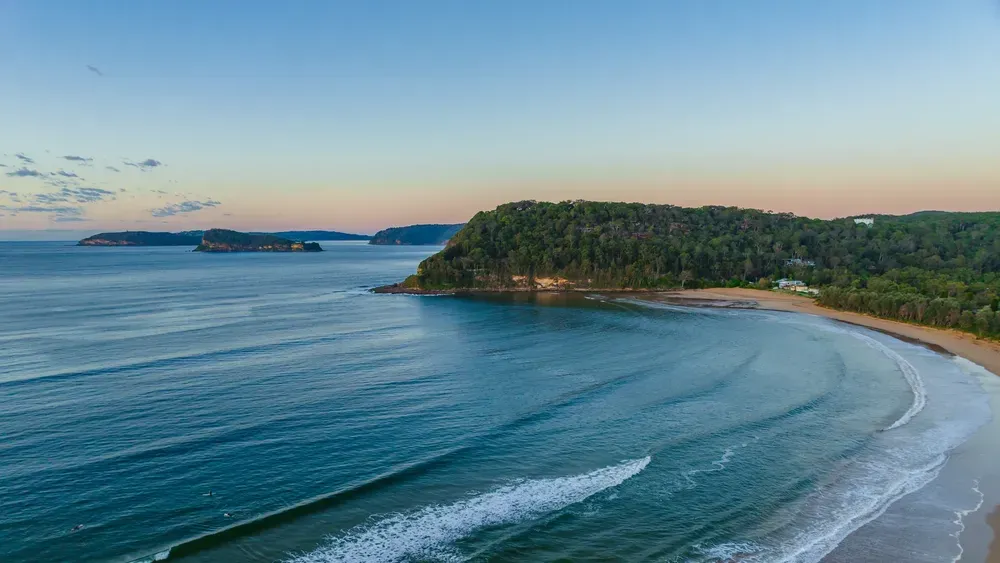
The festival concludes on Sunday, 2026-10-04, with Coastie Carnie Fair Day at the Peninsula Recreation Precinct in Umina Beach. The free, all-ages event is scheduled to include live entertainment, market stalls, food vendors, community groups, family activities and the Puparazzi Pooch Parade.
Umina Beach gives the closing celebration a distinctly local quality. Instead of concentrating the festival solely in a central business district, the Fair Day places queer community celebration near the shoreline, where visitors can combine the event with time at the beach and exploration of the surrounding peninsula.
The festival offers both free and ticketed events. Travelers should consult the official Coastal Twist website for the latest program, venue information and ticket availability because individual event details may change.
Why it is becoming a hidden gem
The Central Coast is not usually the first Australian destination associated with LGBTQIA+ travel. That relative lack of international recognition is precisely what gives Coastal Twist its emerging appeal. The destination offers a queer cultural experience that is community-led, regionally grounded and connected to beaches, cafés, waterways and national parks rather than defined exclusively by large-scale nightlife.
The festival is supported by Central Coast Council and Create NSW, with that support described as contributing to arts, culture, community development and opportunities for local artists and audiences. Its 2026 program further links local talent with nationally recognized performers, giving the region a platform while drawing visitors from beyond the Central Coast.
For queer travelers, the attraction is therefore twofold: Coastal Twist provides a visible, affirming space for LGBTQIA+ people, while the wider region offers a slower itinerary built around coastal landscapes and local cultural participation. The result is less a conventional Pride weekend than a regional cultural getaway—one where a beach outing, a First Nations performance, a youth showcase, a drag act and a community fair can all belong to the same trip.
The most compelling evidence of the Central Coast’s emergence is not a claim that the region has replaced Australia’s established queer destinations. It is that a recurring festival is creating sustained space for LGBTQIA+ artists, young people, families, visitors and local residents in a place that has traditionally received less attention in international queer travel coverage. Coastal Twist’s 2026 edition makes that development visible—and gives travelers a timely reason to look beyond the usual Australian itinerary.
by Chris Tremblay
Copyright EDGE Media Network. All rights reserved. This material may not be published, broadcast, rewritten, or redistributed.
The 37th Hong Kong Lesbian and Gay Film Festival, held from September 4th through the 20th, brought international and local queer storytelling to cinemas across the territory while connecting travelers with Hong Kong’s dense neighborhoods, food traditions, nightlife, and creative communities.
Hong Kong’s appeal for queer travelers is less immediately visible than the nightlife districts of Bangkok, the Pride infrastructure of Taipei, or the beach resorts of Thailand and the Philippines. Its welcome is often found instead in cinemas, independent cultural venues, neighborhood restaurants, and a community accustomed to building visibility through art.
That cultural welcome was especially clear during the 37th Hong Kong Lesbian and Gay Film Festival, which ran from September 4-20, 2026. The festival presented 37 feature films and 38 short films at Broadway Cinematheque, Premiere Elements, and Palace ifc, making it one of the most substantial recent queer cultural programmes in the city.
For visitors, the festival offered more than a schedule of screenings. It provided a practical way to encounter Hong Kong through the people and places that sustain its LGBTQ+ cultural life. Opening and closing events were held in partnership with Soho House Hong Kong, while the cinemas placed audiences in markedly different parts of the city: Broadway Cinematheque in Yau Ma Tei, Premiere Elements in West Kowloon, and Palace ifc in Central.
A festival that doubles as a city guide
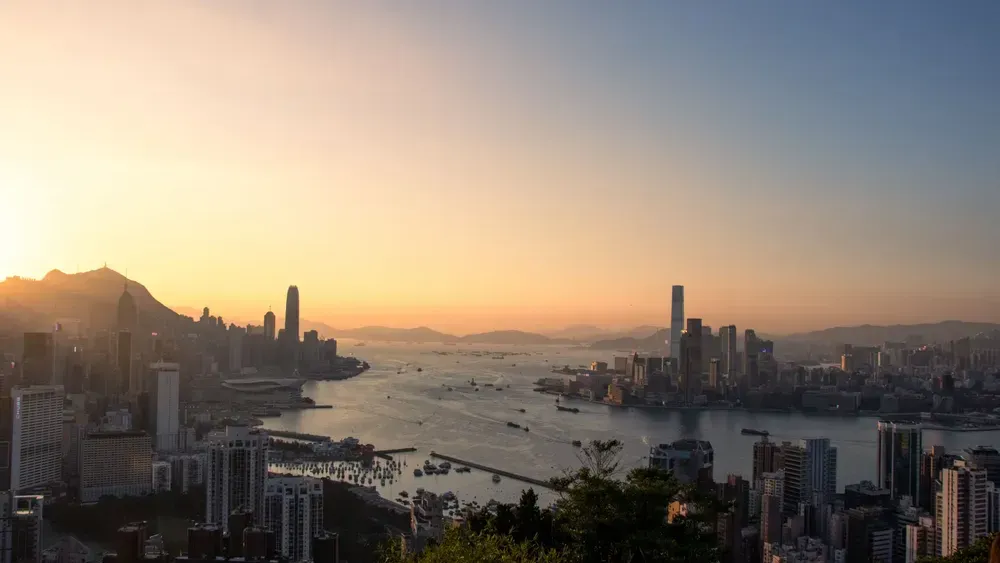
The geographic spread of the festival mirrors Hong Kong’s character. A traveler can move from the neon-lit streets and market lanes of Yau Ma Tei to the polished towers of Central and then across to the museums, performance spaces, and waterfront promenades of West Kowloon. Hong Kong’s Mass Transit Railway provides connections between Hong Kong Island, Kowloon, and the New Territories, making it possible to build an LGBTQ+-focused itinerary without limiting a trip to one nightlife district.
Yau Ma Tei and nearby Jordan are particularly useful bases for travelers interested in the city’s everyday textures. Temple Street’s food stalls, herbal shops, small restaurants, and crowded sidewalks provide a sensory contrast to the festival’s darkened theatres. The area is also close to the waterfront and to the cultural institutions of West Kowloon, where visitors can pair a film screening with galleries, museums, or an evening walk.
Kowloon City offers a different kind of cultural itinerary. The Hong Kong Tourism Board describes the district as a place where historical layers can be explored through sites including Sung Wong Toi, the archaeological display at Sung Wong Toi MTR Station, and Kowloon Walled City Park. The neighborhood is also known for its Thai food community, giving travelers a chance to move beyond the conventional Central-and-Tsim Sha Tsui circuit.
For queer travelers, that combination of cultural depth and public transport is significant. A destination does not have to advertise itself exclusively as an LGBTQ+ resort to offer meaningful access to queer life. In Hong Kong, film festivals, bars, cafés, bookstores, arts venues, and social groups can form a network that is dispersed rather than concentrated.
Visibility through storytelling
The Hong Kong Lesbian and Gay Film Festival’s longevity is itself a marker of continuity. The 2026 edition was the festival’s 37th, and its programme was reported as its largest in recent years. It included films from across the world and used multiple thematic groupings to organize stories around different moods and experiences.
The programme also demonstrated how queer communities use cultural events to create public space. A festival screening is comparatively accessible: visitors can attend alone, with a partner, or with friends; listen to local audience reactions; and meet people in a setting organized around queer stories rather than around assumptions about identity. That makes cinema a particularly useful bridge for travelers who may not know Hong Kong’s community networks.
The festival’s official celebrations also extended beyond the theatre. The Beat Asia reported that the opening party took place at Soho House Hong Kong in Sheung Wan on September 4th and that the closing party was scheduled for September 19. Those events gave visiting audiences opportunities to participate in the social side of the festival while remaining connected to established local venues.
Other queer cultural activities were taking place during the same period. The Beat Asia listed the 2026 Hong Kong Lesbian and Gay Film Festival alongside Margarita Mile, a citywide cocktail trail running from 9/1 to 9/16 across 10 bars. Although Margarita Mile was not itself an LGBTQ+ event, its presence illustrated the city’s broader bar and hospitality infrastructure, which can give queer visitors options beyond explicitly LGBTQ+-branded venues.
A welcome with important limits
Hong Kong should not be presented as an uncomplicated LGBTQ+ haven. Its legal environment remains incomplete. The Equal Opportunities Commission has reported that Hong Kong does not have comprehensive anti-discrimination legislation covering sexual orientation, gender identity, or intersex status, and that same-sex couples cannot marry there under local law.
At the same time, Hong Kong’s courts and public institutions have recognized some rights and benefits for same-sex couples in particular circumstances. The Community Legal Information Centre states that overseas same-sex marriages may be regarded as valid for certain purposes, including immigration visas, inheritance, public rental housing, tax assessment, and parental rights, while emphasizing that same-sex couples still cannot marry in Hong Kong.
That distinction matters to travelers. Cultural visibility, social ease, and legal equality are not the same thing. A queer visitor may find a welcoming festival audience and an active creative scene while still needing to understand the limits of local legal recognition. Transgender travelers should also consult current official travel and identity-document guidance before departure, particularly if documentation does not align across bookings, immigration records, and identification.
The festival therefore matters not because it proves that every LGBTQ+ traveler will experience Hong Kong in the same way, but because it offers evidence of a durable public queer culture. Its 37-year history, international programme, and cooperation with multiple cinemas show a community able to claim space through storytelling and collective attendance.
Why Hong Kong is emerging as a hidden gem
Hong Kong’s strength as an emerging queer destination lies in its layering. A visitor can attend a lesbian and gay film screening, eat noodles or Thai food in Kowloon City, explore the history of Kowloon Walled City, ride the MTR across the harbor, and end the night in a community-linked bar or cultural venue. The experience is not built around one parade, one resort strip, or one officially designated LGBTQ+ quarter.
That makes the city especially attractive to travelers seeking queer culture alongside history, architecture, food, and cinema. The Hong Kong Lesbian and Gay Film Festival provides a timely anchor, but the deeper appeal is the network around it: audiences, filmmakers, venues, neighborhood businesses, and community organizers who keep queer stories visible.
Travelers planning a future visit should verify festival dates, venue locations, ticket availability, and local legal guidance directly with organizers and official institutions. The 2026 festival has ended, but its recent programme shows why Hong Kong deserves consideration as a culturally rich, less predictable destination for LGBTQ+ travelers in Asia.
by Chris Tremblay
Copyright EDGE Media Network. All rights reserved. This material may not be published, broadcast, rewritten, or redistributed.
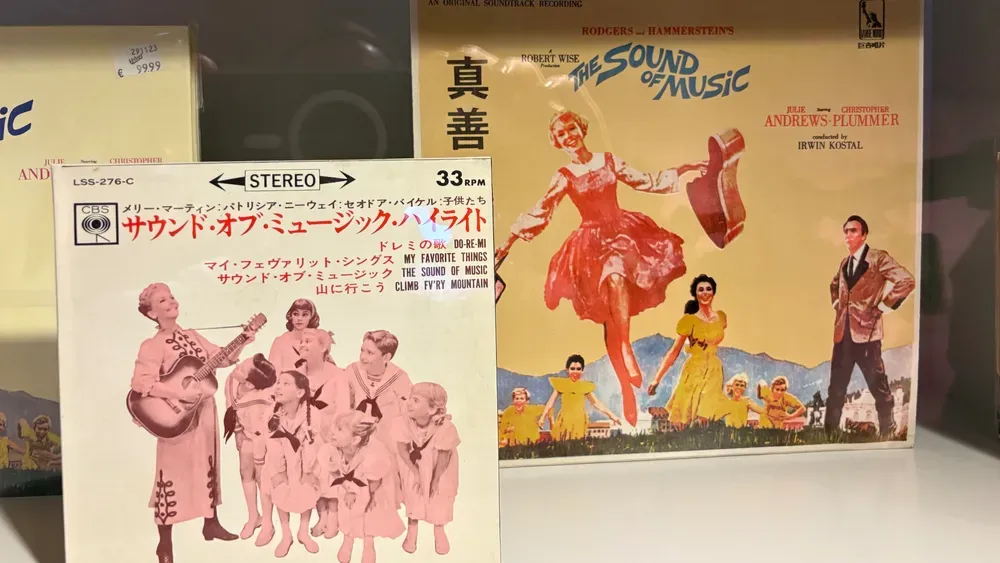
In this photo taken with a smartphone, records with the film score of the musical film "The Sound of Music" are displayed in the exhibition of the new "Sound Of Music Salzburg" museum in Salzburg, Austria, Sunday, Sept. 20, 2026.Photo Credit: Philipp-Moritz Jenne
An Austrian museum is now alive with “The Sound of Music.”
SALZBURG, Austria — An Austrian museum is alive with “The Sound of Music,” a first-ever venue devoted to the classic 1965 singalong movie starring Julie Andrews.
The Sound of Music Salzburg museum, situated in an Austrian city famed for music and perhaps best known as the home of Wolfgang Amadeus Mozart, opened Sunday.
The attendees included Elisabeth von Trapp, granddaughter of Georg and Agathe von Trapp, whose family story inspired the Rodgers & Hammerstein musical and Hollywood blockbuster. She continues to give guided tours of movie sites in Salzburg today.
“It is intimate enough so you really have a beautiful sense of the storyline of both the Sound of Music and the Trapp family singers — my relatives. I’m very proud of that,” Elisabeth von Trapp said of the new museum.
Her father, Werner, was one of the original Trapp Family Singers — although moviegoers know his character by another name. “My father is depicted in the movie as Kurt; his name was Werner von Trapp. Just to set the record straight,” von Trapp said.
Housed in the 17th-century Hellbrunn Palace, where many scenes from the film were shot, the museum distinguishes the real-life story of the von Trapp family from that of the 1959 Broadway musical and later the Hollywood blockbuster.
Set against Nazi Germany’s annexation of Austria in 1938, the story centers on a governess named Maria who teaches seven children in the von Trapp family to sing and love music — before falling in love with their father and her employer, widower Georg von Trapp.
Museum officials note the real von Trapp, a submarine commander in the Austro-Hungarian navy, was “not a strict paternalist” — as he was depicted by the film’s leading man, Christopher Plummer — but “a considerate, albeit much-burdened, father.”
Visitors are treated to nearly 450 objects including props and costumes from the film, cinema posters and recordings of the music. A centerpiece is the gazebo where teenagers Liesl von Trapp and her suitor Rolf sing the courtship duet “Sixteen going on Seventeen.”
Fans of the film — which collected five Oscars including best picture — have long flocked to Salzburg: Several hundred thousand visit the city each year.
John and Terry Combs, a couple from Dayton, Ohio, were accompanying von Trapp on her walking tour through Salzburg.
“I love the combination of it being much about the movie, of course, but about the real von Trapp family, which I’ve read much about over the years,” said Terry Combs. “And having met and known Elisabeth a little bit — it just brought it full circle.”
The new exhibition is open daily until Nov. 1. After a brief bidding of “So long, farewell” to visitors late this year, the museum is scheduled to reopen next March.
by Philipp Jenne
Copyright Associated Press. All rights reserved. This material may not be published, broadcast, rewritten, or redistributed.
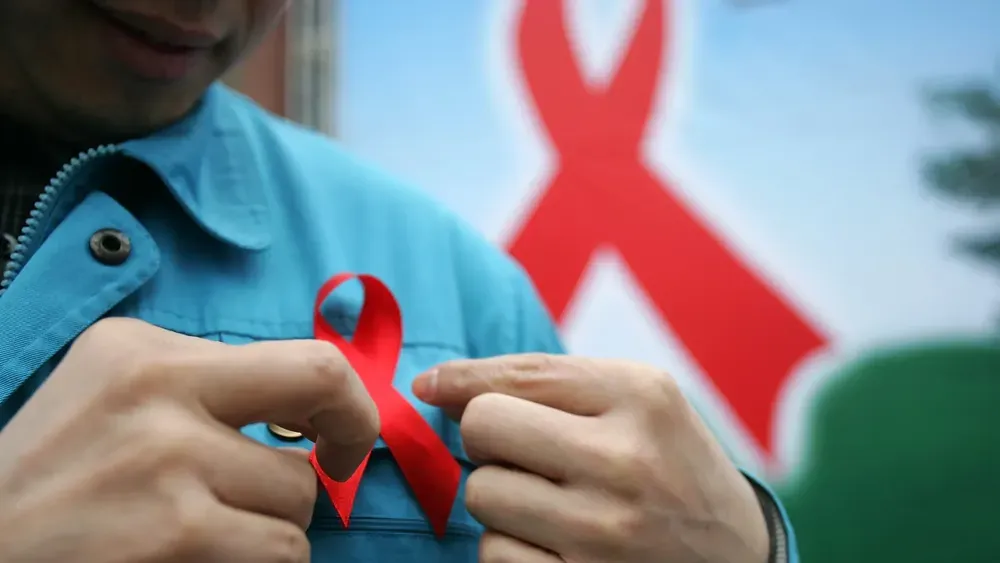
Fiji has formally declared HIV a national emergency after a sharp increase in new diagnoses, with health authorities estimating that approximately one in 60 adults is living with the virus.
Fiji formally declared HIV a national emergency on September 15, 2026, following a rapid rise in new infections and a government assessment that the existing outbreak response was no longer sufficient. Health and Medical Services Minister Ratu Atonio Lalabalavu said the declaration recognized “the seriousness of the epidemic and the urgent coordinated response our country now needs.”
The declaration followed a Cabinet decision on September 9 and was made under Fiji’s public-health emergency framework; the World Health Organization described the country as experiencing one of the sharpest increases in new HIV infections globally.
Fiji reported 2,016 new HIV diagnoses in 2025, a 27% increase from the previous year, according to figures cited by Reuters from a government statement. The 2025 total was 16 times the number recorded in 2019, according to figures reported by Fiji media from the Health Ministry’s emergency declaration. UNAIDS estimates that about 9,100 people in Fiji were living with HIV in 2025, compared with an estimated 760 people in 2010. The estimate means that approximately one in 60 adults in the Pacific island nation is living with HIV.
The recent increase has drawn attention to multiple routes of transmission, including sexual transmission and the sharing of injecting equipment. According to UNAIDS figures cited by Reuters, more than half of cases with a known transmission route were associated with sexual transmission, while more than 42% were linked to injecting-drug use. The figures do not mean that any particular community is responsible for the increase, and public-health agencies have emphasized access to prevention, testing and care rather than blame.
UNAIDS estimates that only 39% of people living with HIV in Fiji knew their status in 2025, while 22% were accessing treatment. Antiretroviral treatment enables people living with HIV to remain healthy and, when the virus is maintained at an undetectable level, prevents sexual transmission of HIV.
Government Response
The government has announced free, voluntary and confidential HIV testing, prevention medicines, harm-reduction services and treatment for people diagnosed with HIV. The planned measures include wider access to pre-exposure prophylaxis, commonly known as PrEP, which is medication that reduces the risk of acquiring HIV for people who may face substantial exposure. Fiji also plans to establish a needle-and-syringe program for people who inject drugs.
Authorities have said that services are available nationwide and that discrimination against people living with HIV is illegal.
by Chris Tremblay
Copyright EDGE Media Network. All rights reserved. This material may not be published, broadcast, rewritten, or redistributed.